How Can Proper Yard Grading Prevent Water Problems Around Your Home?
Shawn
|
November 11, 2026
Table Of Contents
Correct yard grading for drains can eliminate major structural water intrusion issues through the proper elevation of surface runoff, roof runoff, and saturated ground by leveraging the force of gravity. Sloping the land downward (generally 6″ over the first 10′ from the foundation wall) is the practice of shaping the land to shed water and prevent flooded basements, cracked foundation walls, growth of mold in crawl spaces, erosion of topsoil and the buildup of hydrostatic pressure.
Ground it the right way for slope control where it matters around your property. Site assessment, note natural contours & drainage flow patterns, measure foundation to yard elevation loss with a line level or transit, grade off compact dirt and debris along the perimeter, install clay-backed fill soils for support, and shape swales or drains. French drains in low flat areas, run downspout discharge piping past grading areas, and bring in an experienced landscape drainage or excavation contractor for re-sloping the heavy lifting.
Fundamentals: Positive and Negative Yard Grading for Drainage
Knowing how water infiltrates your property can help you avoid moisture-related foundation failure.
1. Positive Grading (The Structural Standard)
Your residential yard grading should slope at a consistent grade from the entire perimeter of your home outward. The international code for residential building code suggests that a slope drop of at least 6 inches in the first 10 feet from the foundation (5% grade slope) helps the high-volume surface runoff get past backfill soil areas before soaking into deep foundation walls.
2. Negative Grading (The Core Risk Factor)
Negative grading is where the grade slopes inward towards the house foundation. Most often, a negative grade appears as backfill around the house settles and compacts in its natural course in the years following construction. But during a heavy rainstorm, the negative grade acts as a barrier to rainwater by damming it up against the basement wall.
Some of the Main Water Issues that Proper Yard Grading can Avoid
Proper lawn sculpting creates a key outward barrier to harmful moisture dangers.
1. Eliminate Hydrostatic Pressure
A wet, saturated yard is extremely heavy and hits the bottom of your foundation with thousands of pounds of horizontal force, called hydrostatic pressure. The accumulated weight of water pushes basement walls inward until structural horizontal cracks open in concrete blocks and poured walls, releasing water through tiny concrete pores.
2. Protection from Mold in the Crawl Space and Rot in the Wood In homes with pier-and-beam or crawl space foundations, defective grading directs ground runoff directly beneath the floor framing. Long standing moisture in dark crawl spaces rots structural floor joists, leads to the collapse of sagging subflooring, and shoots deadly airborne mold spores upward into a home’s living spaces via the stack effect.
3. Prevent Yard Flooding of Soil Erosion and Landscape Destruction
Surface water carving over a lawn, levelling or gentle sloped yard sweeps away your yard’s topsoil, exposes shallow tree roots and destroys grass lawn turf. As part of the grading process, gentle earth channels known as drainage swales will be constructed to carry rainwater safely to the city storm drains.
Yard Drainage Peril Summary
● Critical Structural: Pushes water towards the foundation walls, leading to basement flooding and cracks in the structure.
● Pressure due to rising water: Excellent structural risk; basement walls bow inward with lateral water weight, corrected by positive re-sloping and surface swales.
● Crawl Space Saturation: High health and framing risk; standing water under subfloor: rots wood, causing loss of joist system.
● Unchanneled downspouts: Moderate to high risk: dumps concentrated roof runoff at corners of foundation and at edges; needs extending pipe feed outside grade.
Complementary Drainage Solutions to Support Proper Grading
Creating a positive slope is the first step in site drainage, but great storm protection is achieved with a combination of grading with components of subsurface drainage.
1. Downspout Extension Pipe
Roof runoff is captured in gutters that can collect thousands of gallons of rainwater with a single storm. Discharge elbows sending water at foundation corners devastate positive slope. Running rigid PVC or corrugated pipe underground to an extended downspout is an effective way to keep significant amounts of roof runoff from again saturating perimeter backfill.
2. French Drains & Landscape Swales
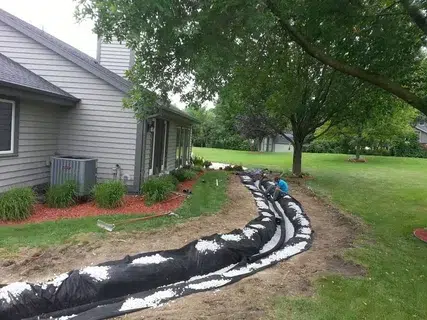
In properties confined by adjoining lots or creating steep uphill slopes, grading may not divert all surface water. A French drain (perforated pipe set in a gravel-filled trench) or a shallow grassed swale effectively intercepts surface or subsurface water and redirects it away from your home.
Reasons to Use Experts for Your Yard Grading
Site slope correction is not as simple as shovelling dirt to get against a wall. It takes accurate elevation maps, knowledge of soil types and heavy machinery to do it right.
Excavation and drainage professionals utilise laser transits and survey tools to determine the accurate slope ratios that will direct water off of your property and out into the surrounding neighbourhood, without flooding others or breaching watershed regulations.
Filling loose garden topsoil adjacent to a foundation wall is a failure. Skilled landscapers install clay soil bases of dense, low-permeability clay soil covered by permeable topsoil, well compacted, to withstand the forces of water and gravity.
Machine operators keep underground utilities, gas lines and irrigation systems free of harm. And technicians also preserve essential siding clearance (the soil line is 4 to 6 inches below the siding line, which is crucial to blocking access by termites and rotting wood).
Conclusion
Positive yard grading is the most critical factor in the fight against foundation water damage, flooded basements and structural soil movement. A yard grade that slopes away from the home at 6″ in the first 10′ forces gravity to guide surface water safely away from the foundation.
When coupled with downspouts that extend further from the house, drainage swales to direct stormwater and a team of professionally trained excavators, positive yard grading achieves decades of dry, structurally solid, fully protected stability.
FAQs
1. How much should the ground slope away from a house foundation?
Building codes recommend a minimum slope drop of 6 inches over the first 10 feet (a 5% grade) extending away from your foundation perimeter.
2. What type of dirt should be used for foundation grading?
Use a heavy clay-heavy soil base near the foundation because clay packs tightly and resists water penetration.
3. Can improper yard grading cause basement wall cracks?
Yes. Negative grading causes water to pool against basement walls, generating high hydrostatic pressure that forces concrete to bow inward and crack over time.
4. Is landscaping mulch alone enough to fix a grading problem?
No. Mulch is light and porous; water flows right through it to the dirt below.
5. How can I tell if my yard has poor grading?
Look for standing water puddles within 6 feet of your foundation after heavy rain, with soil shrinking away from walls.
After a severe storm, the first thing most homeowners notice is the mess: snapped branches across the lawn, a cracked limb hanging over the driveway, or a heavy bough resting…
Fences and property boundaries help define outdoor spaces, protect property, and maintain clear separation between neighboring areas. However, when weeds, vines, shrubs, and unwanted trees begin growing along these boundaries,…
When most people hear professional landscaping, their first thought is usually “curb appeal.” And while a well-manicured lawn and vibrant flowerbeds certainly catch the eye, the value of professional landscaping…